Viking Gate Repair in Sacramento: A Homeowner’s Guide
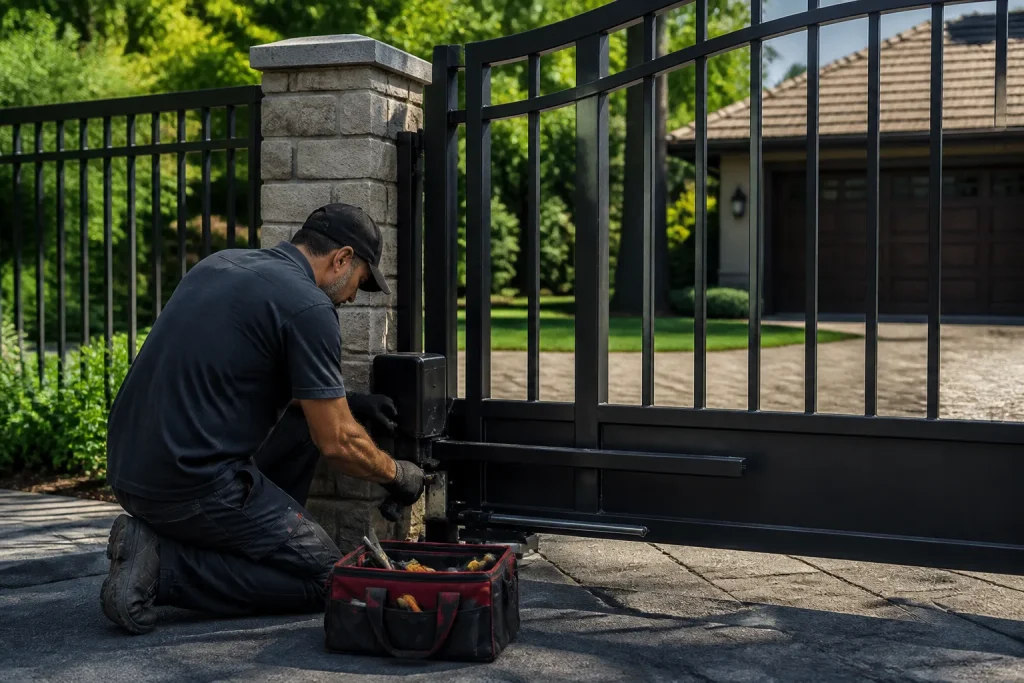
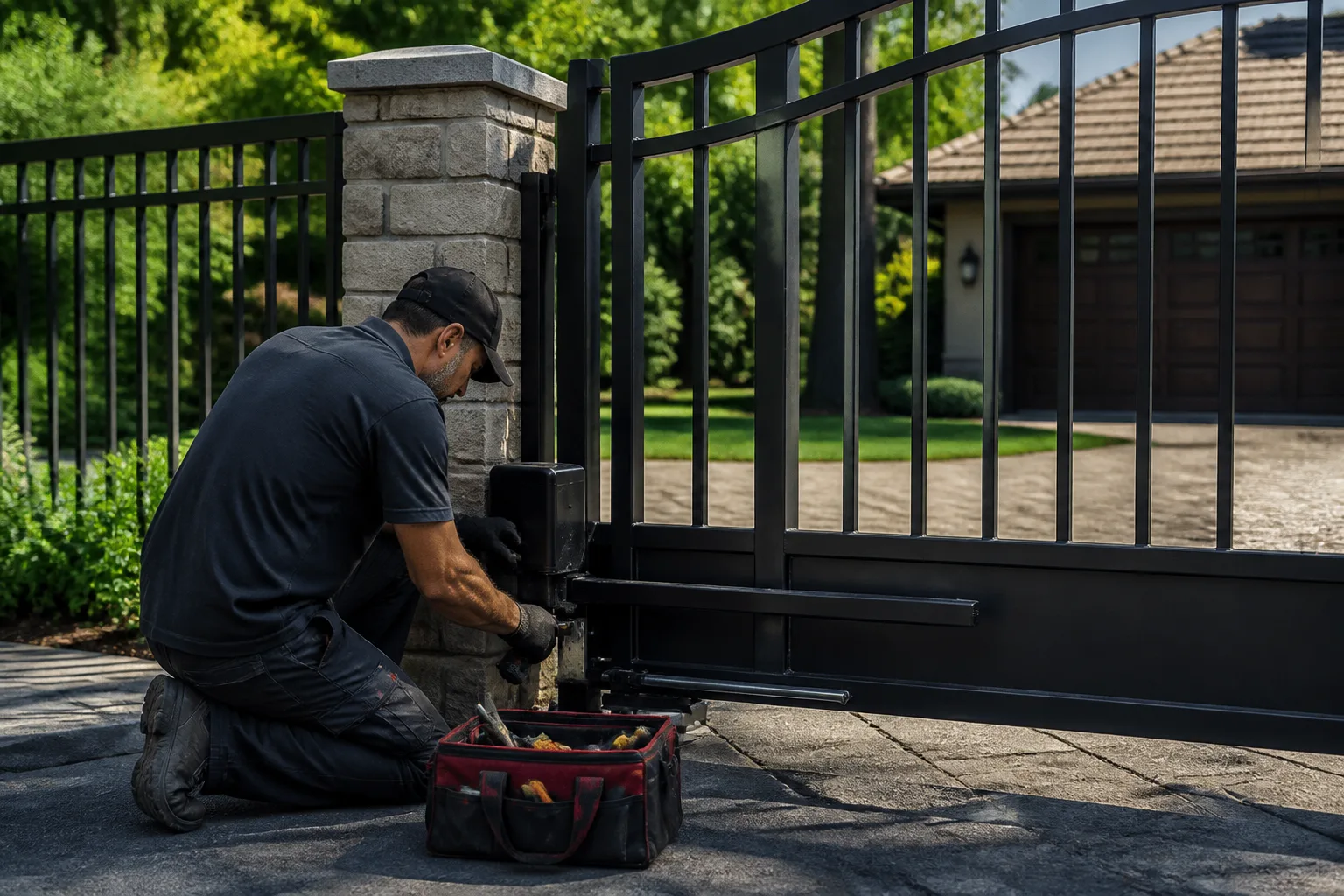
Viking gate operator repair in Sacramento typically costs between $280 and $650 depending on whether the issue is a clutch adjustment, control board fault, or full motor replacement. Most Viking repairs on residential and HOA properties in Sacramento can be diagnosed and completed same-day by a technician with brand-specific experience. If you’d rather not troubleshoot yourself, call Highpoint Gate Repair California at (866) 550-7854 for a free estimate.
Here’s the mistake we see weekly across Sacramento County: a gate starts moving, grinds under load, then stops dead. The property manager calls a general gate company. They show up, swap the motor for $800, and leave. Two weeks later, same problem. What actually happened? Viking’s V2000 and V6000 series have an internal clutch designed to slip under excess load — it mimics motor failure perfectly. The motor was fine. The clutch needed adjustment. That’s $800 wasted on a misdiagnosis that takes five minutes to verify if you know what to look for.
Clutch Slip vs. True Motor Failure: The Symptom Pattern
Viking operators use a mechanical clutch as a safety buffer between the motor and the drive assembly. When the gate encounters resistance — debris in the track, a misaligned rack, or even ice after a cold Sacramento night — the clutch slips rather than forcing the motor to stall.
The signature pattern is specific: the gate begins to open or close normally, then halts abruptly under load. The motor hums or clicks but produces no movement. A technician unfamiliar with Viking hears that click, assumes stripped gears or a burnt motor, and orders a replacement.
In our experience across Sacramento neighborhoods from Natomas to Land Park, about 30% of “motor failures” on Viking V-series operators are actually clutch adjustments. The test is simple: disconnect the gate arm and run the operator unloaded. If the motor cycles freely, the clutch is slipping under load, not the motor failing. Adjusting clutch pressure takes fifteen minutes. Replacing a motor takes two hours and costs six times as much.
We’ve had property managers in Elk Grove tell us the previous company replaced their Viking motor twice in eighteen months. Both times, it was the clutch. That’s not bad luck — that’s brand-agnostic diagnosis on a brand-specific machine.
Corrosion at the Motor Housing Junction: Sacramento’s Wet-Winters Problem
Northern California’s winter rains create a specific failure point on Viking operators that technicians in drier climates rarely encounter. Viking’s industrial-grade wiring harness uses a multi-pin connector at the motor housing junction. The seal is adequate for normal conditions, but Sacramento’s combination of seasonal heavy rain, temperature swings, and occasional standing water at low-lying commercial properties pushes moisture past the gasket.
The corrosion starts at the ground pin and spreads. Symptoms develop gradually: intermittent operation, random fault codes on the MSC2 board, or complete shutdown after a storm. A technician who doesn’t know Viking’s harness routing will chase the control board or replace the transformer while the real problem sits inside a $12 connector.
Proper repair means more than swapping the connector. The harness needs to be rerouted above the splash line where possible, the junction re-sealed with marine-grade dielectric compound, and the motor housing drain checked for blockage. We’ve done this repair on Viking operators at Sacramento apartment complexes along the American River where seasonal flooding is a recurring issue. The fix holds when it’s done completely, not patched.
On one job in North Sacramento last winter, we traced a “dead” V6000 to corrosion so advanced the pin had dissolved into green powder. The property’s maintenance staff had already received a quote for full operator replacement. Two hours of harness work and the operator ran for another four years.
Reading the MSC2 Control Board Without Dealer Software
Viking’s MSC2 control board has a self-diagnostic system that competitors’ boards lack, but it’s not as accessible as it should be. The board displays fault codes through a series of LED flashes — red and green patterns that correspond to specific conditions like overload, limit switch fault, or thermal trip.
Here’s what the MSC2 can tell you directly:
- Steady red: Power present, board functional
- Flashing red (2x): Motor overload / thermal protection active
- Flashing red (3x): Limit switch out of sequence or failed
- Flashing red (4x): Obstruction detected on close cycle
- Alternating red/green: Board receiving conflicting inputs
What the MSC2 cannot self-diagnose: clutch slip percentage, harness resistance degradation, or rack alignment stress. Those require meter testing and physical inspection. The LED codes point you toward the symptom area, but they don’t replace hands-on diagnosis.
Dealer-level software exists for deeper diagnostics, but in eleven years we’ve never needed it to complete a repair. The LED codes plus systematic testing — amperage draw under load, limit switch continuity, harness resistance — give us everything required. That’s the difference between a parts-swapper and a repair technician. We’ve worked on Viking operators in Sacramento commercial properties where the previous company had been “waiting for the Viking dealer to come out” for three weeks. We had it running same day with a $40 harness repair.
Pedestrian Entry Mode: The Misconfiguration That Mimics Sensor Failure
Viking operators include a pedestrian entry mode — partial opening for foot traffic — that’s configured through the MSC2 board. When this mode is improperly set or accidentally triggered by a programming error, the gate opens twelve to eighteen inches, pauses, then reverses. Property managers understandably assume a safety sensor is falsely detecting an obstruction.
We’ve been called to Sacramento HOAs where the board had been replaced twice, photo eyes swapped, and loop detectors recalibrated — all for a pedestrian mode that got activated during a power surge or button-mashing by a resident. The giveaway is consistency: a true sensor fault is random and weather-sensitive. Pedestrian mode reversal happens at the exact same point every cycle.
Resetting the mode requires accessing the MSC2 programming sequence, which is documented in Viking’s manual but rarely understood by general gate technicians. The steps are specific: enter program mode, cycle to the pedestrian opening distance setting, verify or reset to zero if full opening is desired, exit and test. Takes five minutes if you know the button sequence. Takes a $400 service call if you don’t.
We found this exact issue at a property near Sacramento State last month. The manager was ready to replace the entire access system. It was a single setting, changed during a storm-related power fluctuation.
Rack and Pinion Alignment: The 3mm Tolerance
Viking’s rack and pinion drive system is robust but unforgiving. The pinion gear on the operator must mesh with the rack mounted to the gate at a specific depth and angle. Viking specifies a tolerance of roughly 3mm in any direction. Beyond that, the motor draws excess amperage, the clutch slips repeatedly, and thermal protection trips — creating the same “motor failure” symptoms we discussed earlier.
The alignment degrades gradually. Gate posts settle. Concrete heaves during Sacramento’s dry summers and wet winters. Vehicles bump the gate. Each shift is imperceptible until the cumulative misalignment crosses that 3mm threshold.
Testing requires a straightedge and feeler gauge, not guesswork. We check rack engagement depth, verify parallel alignment across the full gate travel, and inspect for worn rack teeth that allow the pinion to ride high or low. When we find structural movement in the post or footing, our in-house welding capability lets us reinforce or reposition mounting hardware on the same visit. Most competitors can only shim and hope. We’ve fabricated custom mounting brackets on-site for Viking operators in Sacramento’s older neighborhoods where original gate structures have shifted over decades.
One repair in East Sacramento involved a V2000 that had been “repaired” four times in two years. The rack was riding 5mm low due to a settled post. Previous technicians kept adjusting the operator position to compensate, which worked briefly until the next settlement. We welded a new mounting plate, realigned the rack properly, and solved it permanently.
When to Call a Pro
If your Viking operator shows any of these patterns — starts-then-stops under load, intermittent faults after rain, consistent reversal at partial opening, or repeated thermal shutdowns — the diagnosis requires brand-specific knowledge. General gate companies can maintain most operators, but Viking’s industrial design and proprietary control systems reward technicians who work on them regularly.
Isaac and his team have worked on every major gate brand — your system is not unfamiliar territory. When structural damage or broken metal is the problem, welding gets done on-site — no second contractor, no second visit. 11 years, one specialty: gates.
Related services in Sacramento: Highpoint Gate Repair California home for full gate repair and installation services.
The Bottom Line
Viking operators are built for heavy use, but their industrial quality doesn’t eliminate specific failure points. Clutch slip, harness corrosion, MSC2 misconfiguration, and rack alignment are the four issues we diagnose most often on Viking systems in Sacramento — and they’re frequently misdiagnosed by technicians without brand depth.
Key takeaways:
- Start-then-stop under load usually means clutch adjustment, not motor replacement
- Intermittent faults after rain point to harness connector corrosion at the motor housing
- Consistent partial opening and reversal often indicates pedestrian mode misconfiguration, not sensor failure
- Repeated thermal trips suggest rack and pinion alignment stress drawing excess amperage
- Brand-specific knowledge saves money and prevents repeat service calls
446 jobs reviewed — the track record speaks in numbers, not promises. You get the owner on the job, not a subcontractor dispatched by a franchise. If you’re in Sacramento and your Viking operator needs diagnosis or repair, Highpoint Gate Repair California offers free estimates. Call (866) 550-7854 and we’ll get it sorted.
Frequently Asked Questions
Viking gate operator repair in Sacramento typically ranges from $280 for a clutch adjustment or harness repair to $650 for motor replacement or control board work. Complex jobs involving structural realignment or custom welding can run higher. Call (866) 550-7854 for an exact quote — estimates are free.
Most Viking repairs in Sacramento are completed same-day because we carry common Viking parts and have brand-specific diagnostic experience. Same-day service depends on parts availability and scheduling. Call (866) 550-7854 to check availability — we prioritize inoperable gates and security concerns.
Repair is almost always cheaper if the operator is under fifteen years old and the issue is clutch, harness, or alignment related. Replacement becomes the better value when the motor is genuinely burnt, the MSC2 board is obsolete, or cumulative repairs exceed 60% of replacement cost. We evaluate honestly — no upsell pressure. Call (866) 550-7854 for a free assessment.
This is the classic Viking clutch-slip signature, not motor failure. The internal clutch disengages under excess load to protect the motor. Causes include debris in the track, rack misalignment, or clutch adjustment that has drifted out of spec. A technician who knows Viking can distinguish this from true motor failure in minutes. Call (866) 550-7854 if you’re seeing this pattern — we’ll diagnose it properly.
Written by Isaac Bloom, Owner & Lead Technician at Highpoint Gate Repair California, serving Sacramento since 2015.
Need Gate Repair Help?
Call Highpoint Gate Repair California — licensed & insured, here with fast after-hours help in California.
(866) 550-7854