
Mighty Mule Gate Repair in Sacramento: A Homeowner’s Guide
Mighty Mule gate repair in Sacramento typically costs $180–$420 depending on whether the issue is a simple battery replacement or a control board failure. Most problems with these DIY-friendly operators trace back to installation errors or neglected maintenance rather than defective hardware. If you’d rather not troubleshoot yourself, Highpoint Gate Repair California offers free estimates — call (866) 550-7854.
Here’s the thing most Sacramento homeowners don’t realize: the most common reason a Mighty Mule stops working isn’t a failed motor or a bad circuit board. It’s a battery that was never properly maintained, something the manual buries in fine print and most installers miss entirely. We’ve been called out to Oak Park, Natomas, and Land Park for “dead operators” that just needed a $45 battery and a terminal cleaning. After 11 years of gate-only work, we’ve developed a pretty clear picture of where Mighty Mule units shine and where they struggle — and most of that picture starts with how they were installed in the first place.
Why Battery Health Is Always the First Check
Mighty Mule swing operators — the FM200, FM350, FM500, and FM502 models we see most around Sacramento — run on a 12-volt battery system. The AC transformer trickle-charges the battery, and the battery actually powers the motor. This architecture matters because it means your gate can work fine during a power outage, but it also means the entire system depends on a single lead-acid battery that degrades fast in Central Valley heat.
We’ve pulled units from garages in East Sacramento where the battery was four years old, bulging at the sides, and reading 9 volts under load. The homeowner thought the motor was shot. New battery, clean the terminals with a wire brush, reset the control board — gate runs like new.
What kills Mighty Mule batteries in Sacramento:
- Heat exposure in unshaded control boxes (summer box temps in Sacramento regularly hit 140°F)
- Infrequent cycling that lets the battery sulfate
- Transformer failures that go unnoticed for months
- Corroded terminals creating resistance and false “low battery” readings
We always tell Sacramento homeowners: before you assume the motor or board is bad, test the battery under load with a multimeter. Below 11.5 volts while the gate is moving? Replace it first. If that fixes it, you’ve saved yourself a service call.
The Arm Bracket Problem Nobody Talks About
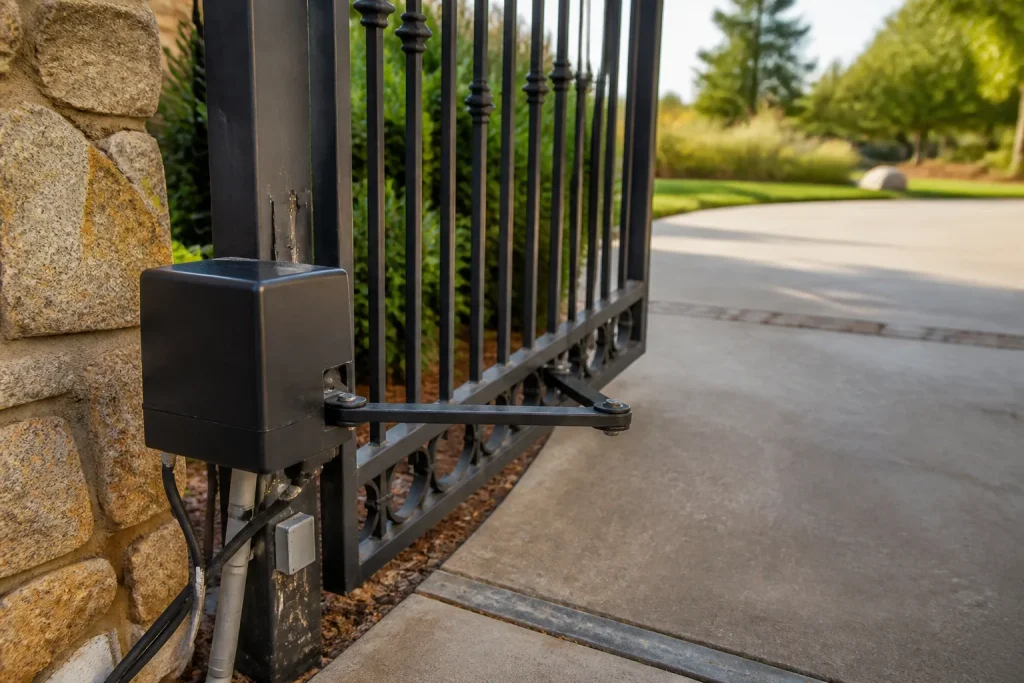
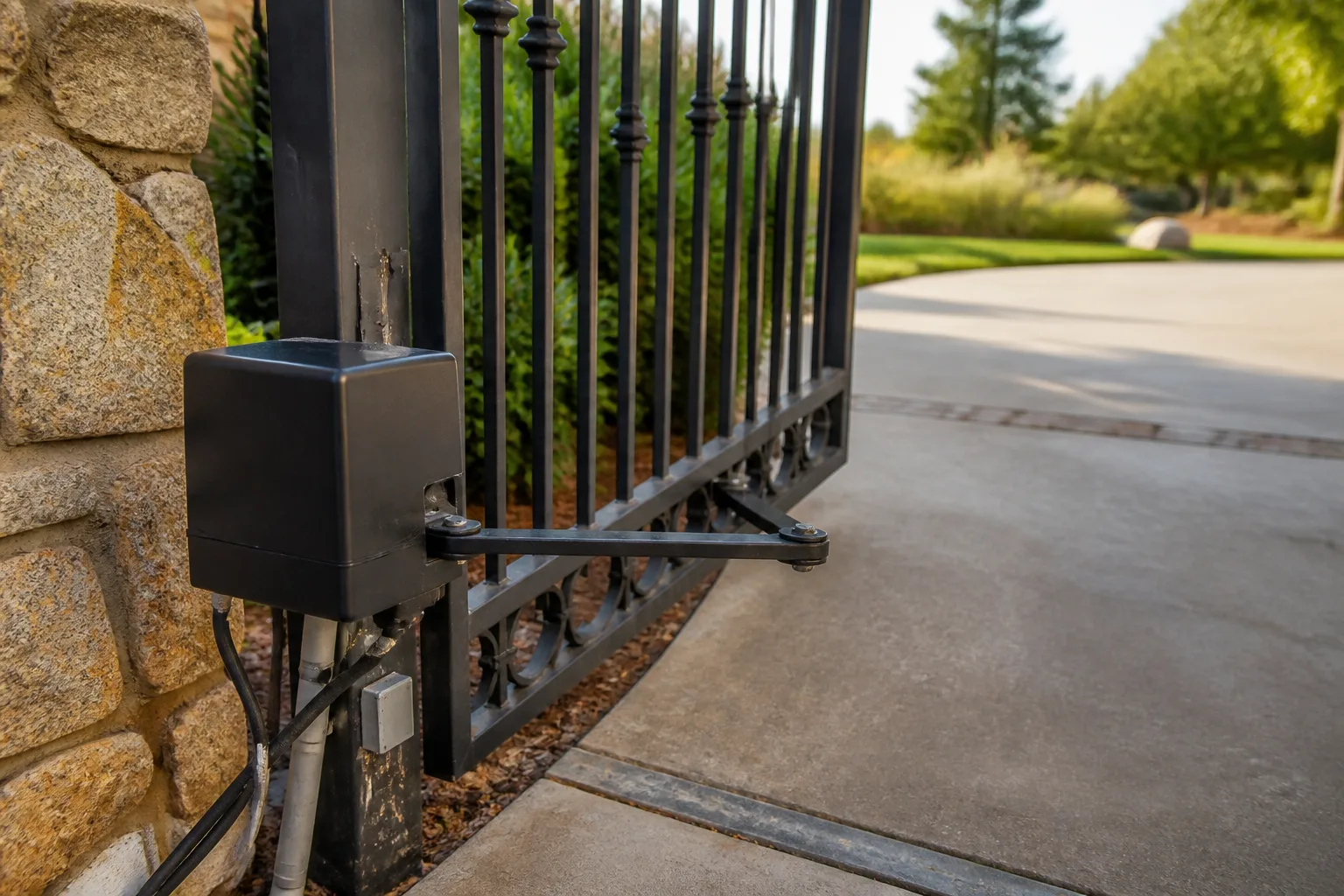
The most frequent mechanical failure we see on Mighty Mule swing gates in Sacramento isn’t in the operator at all. It’s the arm bracket — the point where the operator arm connects to the gate itself. Specifically, the bracket welds crack or the mounting bolts wallow out their holes.
This happens almost exclusively because the gate is heavier than the unit’s rated capacity. Mighty Mule’s FM500 is rated for gates up to 850 lbs and 18 feet. We’ve seen that same motor bolted to a 1,200-lb wrought-iron gate in Arden-Arcade because the original installer either didn’t weigh the gate or figured “close enough.” It isn’t close enough. The operator strains, the bracket takes the stress, and six months later we’re cutting off a broken bracket and welding a reinforced replacement.
Here’s where our in-house welding capability matters. When Isaac Bloom shows up to a Sacramento job with structural damage, we don’t call a second contractor. We cut, fabricate, and weld a new bracket on-site, often upgrading the original design with gusseted corners and grade-8 hardware. One visit. No “we’ll be back next week with a welder.”
Signs your bracket is failing:
- Gate jerks or stalls at the same point in its swing
- Visible gap between the arm and gate frame
- Bolt holes in the gate post are elongated or wallowed
- Operator “hunts” — starts and stops repeatedly trying to find position
Limit Switch Adjustments: The 10-Minute Fix That Stumps Everyone
The FM135, FM500, and FM502 series use magnetic limit switches to tell the operator when the gate is fully open or closed. When these drift out of adjustment — which they do, especially after bracket stress or gate sag — the gate either reverses unexpectedly or stops a foot short of the stop plate.
Adjusting Mighty Mule limits isn’t complicated, but the procedure is specific and the manual explains it poorly. In our Sacramento work, we’ve found that about 30% of “broken” Mighty Mule calls are just limit switches that need recalibration after a gate has settled or a hinge has worn.
The process: power down, manually position the gate at full open, set the open limit magnet, then cycle to full closed and set the closed limit. The catch? If your gate has sagged on its hinges, the magnet positions that worked last year won’t work now. You can chase limit adjustments all day and never fix the real problem, which is mechanical wear upstream.
We check gate plumb, hinge condition, and post stability before we touch a limit switch. In Sacramento’s clay-heavy soils — especially in older neighborhoods like Curtis Park and McKinley Park — gate posts tilt and settle seasonally. Adjusting limits on a gate that’s physically out of square is wasted effort.
Control Board Failure vs. True End-of-Life
Here’s a frank assessment that saves Sacramento homeowners real money: a Mighty Mule control board replacement costs $35–$85 in parts and about 45 minutes of labor. A full operator replacement runs $800–$1,400 installed. We’ve seen too many homeowners pushed toward full replacement when a $40 board swap would restore full function for another 3–5 years.
Board failure symptoms that are actually board failure:
- Transformer tests good, battery tests good, but no response to any input
- Intermittent operation that doesn’t correlate with temperature or battery voltage
- Remote programs but won’t activate (after confirming antenna and range)
- Diagnostic LED shows fault codes that persist after power cycle
When the operator itself is genuinely done:
- Arm gearbox is stripped (grinding noise, no gate movement despite motor running)
- Chassis is cracked or corrosion has compromised structural integrity
- Multiple previous repairs, cumulative cost approaching replacement
- Gate weight and usage have outgrown the unit’s design limits
We pulled one out of a garage over in Pocket-Greenhaven last month where the homeowner had been quoted $1,200 for a new operator. Isaac tested the transformer, swapped the board, cleaned the battery terminals, and adjusted the limits. Total bill: $340. The unit’s been running fine since. That’s the difference between a gate specialist who diagnoses and a company that sells boxes.
When to Upgrade from Mighty Mule to Commercial Grade
We don’t upsell for the sake of it. But after 11 years and 446 reviewed jobs, we can tell you exactly when a Mighty Mule is the wrong tool for the job — and when upgrading to FAAC, LiftMaster, or Linear makes financial sense over trying to band-aid an underpowered unit.
Upgrade is the smarter call when:
| Factor | Mighty Mule Sweet Spot | Upgrade Trigger |
|---|---|---|
| Gate weight | Under 650 lbs | Over 850 lbs, or any steel/wrought iron over 16 ft |
| Daily cycles | Under 15 per day | 20+ daily (multi-family, commercial, busy HOA) |
| Power reliability | Stable grid, occasional outages | Frequent outages, remote property, solar-only |
| Access control needs | Basic remotes, keypad | Telephone entry, loop detectors, multiple code levels |
| Expected lifespan | 5–7 years | 10–15 years, minimal maintenance |
In Sacramento’s commercial corridors along Folsom Boulevard or near the airport, we regularly replace Mighty Mule units with FAAC 770 or LiftMaster CSW24V operators. The upfront cost is higher, but the duty cycle, battery backup architecture, and access-control expandability pay back fast in reduced service calls.
For a typical Sacramento homeowner with a single-family driveway gate, light aluminum or wood construction, and normal residential use? A maintained Mighty Mule with occasional board or battery service is perfectly adequate. The key word is maintained.
When to Call a Pro in Sacramento
We’re not going to pretend every Mighty Mule problem needs a technician. Battery swap, limit adjustment, remote programming — reasonable DIY territory. But here’s where we draw the line based on actual safety risk:
Call a professional for: any repair involving the arm under tension (the gate can drop or swing unexpectedly), electrical work beyond plug-in transformer replacement, or welding/fabrication. We’ve seen homeowners try to re-weld brackets with the gate propped on a jack stand. Don’t. A 400-lb gate falling on you is not a risk worth taking for a $200 service call.
Related services in Sacramento: Gate Motor & Opener in West Covina, Gate Repair in West Covina, and Gate Installation in West Covina.
The Bottom Line
Mighty Mule operators are decent hardware that’s often undone by sketchy installation and ignored maintenance. In Sacramento’s heat, the battery is your canary in the coal mine. The bracket is where hidden gate-weight problems show up. And the control board is usually a cheap fix, not a death sentence.
Key takeaways:
- Test the battery under load before assuming motor or board failure
- Bracket cracks almost always mean your gate is heavier than the operator rating
- Limit switch problems often trace to mechanical gate issues, not electronics
- Board replacement ($40–$85 part) vs. full replacement ($800–$1,400) — know which you need
- Commercial-grade upgrade makes sense for heavy gates, high cycles, or advanced access control
If you’re in Sacramento and your Mighty Mule is acting up, Highpoint Gate Repair California offers free estimates. Isaac Bloom handles the diagnostics personally — no subcontractors, no guesswork. Call (866) 550-7854.
Frequently Asked Questions
Most Mighty Mule repairs in Sacramento run $180–$420. A battery replacement and service is typically $180–$250. Control board swaps run $250–$340. Bracket welding or arm replacement pushes toward $350–$420. Full operator replacement starts around $800. Call (866) 550-7854 for an exact quote — estimates are free.
The most common cause is limit switches that have drifted out of adjustment, often because the gate has sagged on its hinges or the bracket has shifted. Less commonly, the obstruction sensor is oversensitive due to low battery voltage. Check battery health first, then verify gate plumb and hinge condition before adjusting limits.
If you’re comfortable with basic wiring and can match wire-for-wire during swap, yes. Power down completely, photograph the existing connections, and transfer one wire at a time. The safety caveat: if your gate is heavy or the arm is under tension, support the gate independently before disconnecting anything. When in doubt, a professional swap takes under an hour and eliminates the risk of incorrect wiring damaging the new board.
With proper installation and battery maintenance, 5–7 years is realistic in Sacramento’s climate. Heat is the enemy — batteries fail faster, transformer capacitors degrade, and plastic components become brittle. Units that are overloaded (gate too heavy) or cycled heavily (20+ times daily) often fail in 3–4 years. We’ve seen well-maintained, properly specced units last 10 years, but that’s the exception, not the rule.
Written by Isaac Bloom, Owner & Lead Technician at Highpoint Gate Repair California, serving Sacramento since 2015.
Need Gate Repair Help?
Call Highpoint Gate Repair California — licensed & insured, here with fast after-hours help in California.
(866) 550-7854